Home; FAQ; Ask Dr. Gamete; Shop True Life; Donations; About Us; Links; Press Releases; Contact Us



 .
.
"Neither a sperm and egg separately, nor a fertilized egg, is more than a potential baby or a potential adult. So if a sperm and egg are as human as the fertilized egg produced by their union, and if it is murder to destroy a fertilized egg--despite the fact that it's only potentially a baby--why isn't it murder to destroy a sperm or an egg?"
—Carl Sagan"If we intentionally end any stage of a human life in development, we are committing an act of murder, as it has been defined by our society from its humble beginnings. Any attempt to convince ourselves otherwise is little more than a mental joust with reality and an injustice to our unborn that we can never excuse away, try as we may."
—Jon E. Dougherty"We should note that the Hebrew word for conceive is related to the word heat and the passion between a husband and wife that results in conception. God ties the beginning of life with the reproductive act."
—Rev. Robert Fleischmann"Prolifers claim that the abortion of a human embryo or a human fetus is wrong because it destroys human life. But human sperms and human ova are human life, too. So prolifers would also have to agree that the destruction of human sperms and human ova are no different from abortions."
—Dianne N. Irving, M.A., Ph.D"The underlying premise in the arguments pro-abortionists give against fetal personhood is that non-persons can change into persons. They are saying that a living being can undergo a radical, essential change in its nature during its lifetime."
—Dr. Edwin Vieira, Jr.
Our Mission Statement
That life begins at conception is the cornerstone of the right to life movement. Any attempt to deny that the fertilized human ovum is alive and must be accorded the right to life leads to the slippery slope of ratiocination and damnation. If human life does not begin at conception, then when? When the baby first has detectable brain waves? A heartbeat? At quickening? At viability? At birth? At sometime after birth? Perhaps when the baby speaks its first word? After all, the only clear distinction between humans and animals lies in the complexity of our verbal behavior upon which all of our other distinctions and achievements depend. Is infanticide then justifiable on the grounds that the infant cannot yet do anything other animals cannot do?
Clearly the principle that must be upheld is that the fertilized human ovum, having the undeniable potential for becoming a recognizable human being, must be accorded an absolute right to life. On this point we are in perfect agreement with all who are truly pro-life. It would be a capital mistake, however, to base our position on a claim that a fetus, embryo, blastula, morula, or zygote IS a human being. We could hardly hope to be taken seriously if we stridently proclaimed that a single-celled ovum, which even an expert could not recognize as human under a microscope, was to be accorded the right to life because it was already a baby. No, we must give the devil his due and acknowledge that it is the ovum's potential to become a human being that confers upon it its absolute right to life.
Two hundred years ago it would not have been possible to argue that life begins at conception. Nothing was known of genetics, and the whole process of sexual reproduction was still a mystery. Thanks to the advancement of science, we came to understand that conception requires a meeting of egg and sperm. The actual process of fertilization, until recently, was little understood. Whatever happened during fertilization came to be thought of as a mere moment.
We now understand this "moment" much better, and we need to update our thinking accordingly. It is now known that the process of fertilization takes about 24 hours. So where then is the "moment" to be found? Is it when the head of the first sperm burrows into the cell membrane of the ovum? Is it when the head penetrates the membrane? Is it when the acrosome containing the sperm's DNA dissolves? Is it when the sperm's DNA is released into the cytoplasm of the ovum? Is it when the sperm and egg's DNA are drawn close together? When the pronuclear envelopes break? When the chromatin from each pronucleus intermixes to form the diploid zygote nucleus? When the nuclear envelope reforms around the zygote nucleus in preparation for the first mitotic division? Doesn't this sound just like the same slippery slope we have already discussed?
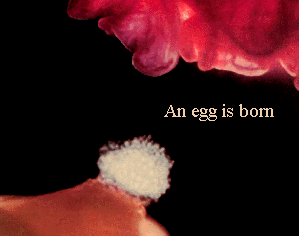
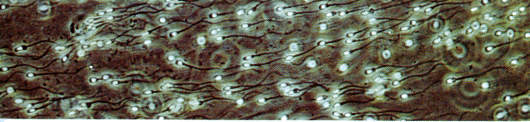
Evidently, as we now know, there is no "moment of conception." The ovum is just as alive before it is fertilized as it is after, and who could deny that sperm are alive and behave purposefully? Does not the ripe, gravid ovum, coursing its way down the fallopian tube, actively emitting chemical signals in the hope of attracting sperm, have a potential for becoming human? Does not the sperm, in their multitudes, swimming vigorously by the hour in their quest to impregnate an ovum, also have a potential to become human?
The destiny of each depends upon the other, but that does not lessen their potential for becoming a human being. Each carries half of the instructions for making a unique human being. Each are genetically unique beings and when the two become one, we begin our development as multicellular organisms. But our true birth came earlier in the process of gametogenesis when a mature egg emerged from its mature follicle, and when sperm emerged from their seminiferous tubules to await their turn--their chance for continued life, in the epididymis before completing their maturation en utero. The unfertilized ovum requires a sperm to unite with if it is to continue its life, but then the conceptus requires a womb to realize its potential for life and so on to the infant who needs love and care to survive. Dependence on a precondition does not eliminate potential nor the right to life.
We assert, therefore, that both egg and sperm live and behave purposefully. Each is endowed with a will to live as each seeks out the other in a life and death bid to become human. Together they have the potential for becoming a human being, and that which has the potential to become human must be accorded the right to life.
We hold that every ovum has a right to life, a right to be fertilized, and every sperm has the right to at least have a chance to fulfill its quest to unite with an ovum. We do, of course, recognize that certain changes in our laws and customs must be made. The necessary changes may seem strange at first, but the dictates of morality demand them to be made.
Among the changes:
 For all women during periods of infertility, sexual intercourse
(involving ejaculation) is to be avoided and should at other times be concidered
obligatory (unless artificial insemination is prefered).
For all women during periods of infertility, sexual intercourse
(involving ejaculation) is to be avoided and should at other times be concidered
obligatory (unless artificial insemination is prefered).
For all fertile men, all acts of extravagnial emission must be
prohibited (unless a sperm donation is being made).
All forms of post-gametogenic birth control are to be banned.
Menstrual exudate, which must be presumed to contain an ovum,
whether fertilized or not, must be collected and given full funeral rights.
We call upon all right-minded people who truly care about the lives of unborn babies to join us in working tirelessly to promote a true understanding of the pro-life point of view, and to bring about the necessary changes in human values and behavior so that we can all one day live in a truly moral society. We realize that initially the ideas we present may seem radical, but please keep an open mind and read our FAQ section for greater clarification of our views.