Introduction
When efforts to prolong the life of a beloved pet serve only to prolong death, euthanasia (Greek for "good death") should be considered. Veterinarians have the means and training to put animals which are beyond treatment and recovery to sleep humanely. While the services of a veterinarian should be one's first choice, some pet owners, for a variety of reasons, are choosing not to take their dying pets to a veterinarian: The services of a vet may not be available when they are needed; transporting the pet to the vet might be too disturbing, causing fear and discomfort in the pet's final hours; cost may be an issue. For whatever reason, some pet owners are attempting at-home euthanasia with varying results. The following information is offered, as a public service, to help these pet owners succeed, and not, by mistake or ignorance, add to their pet's suffering by using questionable, untested, or ill-considered methods such as using engine exhaust fumes.
Of those methods for euthanasia approved by the American Veterinary Medical Association (AVMA) 1, the only method that could be used safely at home involves the use of carbon dioxide. Carbon dioxide (CO2) is heavier than air and nearly odorless. In low concentrations (7.5%) it is an analgesic (pain reliever), and at medium concentrations (30%-40%) it can be used as an anesthetic, causing rapid loss of consciousness without struggling, distress, or excitation. 3 At high concentrations (>80%) CO2 causes quick death. High concentrations, however, painfully irritate eyes and the respiratory tract, so it is important to first induce an analgesic effect, then bring about deep anesthesia (within 1 to 2 minutes) before exposing the animal to high concentrations. Because the AVMA believes that the flow of CO2 can be regulated adequately only by using compressed CO2, only the use of CO2 cylinders is approved. The following method, being adapted for home use, does not require the use of compressed gas cylinders. The AVMA Panel on Euthanasia has not been asked to approve the following method, and no approval is implied. The author is satisfied that the method is sound and readers should judge for themselves.
The AVMA approves the use of CO2 for euthanasia in most small animals including amphibians, birds, reptiles, rodents, and other small mammals weighing less than two pounds (1 kg). Some amphibians and reptiles, however, may breathe too slowly or be able to hold their breath for long periods of time making other methods of euthanasia preferable. Also some burrowing and diving animals (such as some species of rabbit and marine mammals) have prolonged survival times when exposed to CO2. Also excluded from AVMA approval would be all cats and dogs, even small ones. The following method has been tested only on rodents.
Making Carbon Dioxide
You may have had occasion to mix vinegar (5% acetic acid) and baking soda (NaHCO3) together and see all the bubbles produced. The bubbles are carbon dioxide gas, and 1 gram of baking soda reacts with 15 ml of vinegar (or other 5% acid) to produce 291 cc of CO2. In kitchen measurement terms, 1 cup of vinegar reacts with 1.2 tablespoons (3.6 tsp.) of baking soda to produce 1.2 gallons of CO2, or one gallon of vinegar would react with 1.25 cups of baking soda to produce 20 gallons of CO2. Both white vinegar and baking soda are inexpensive, and using more baking soda than the minimum amount given above does no harm.
You might want to expose the animal to the smell of vinegar to see if the odor is distressing or not. Rodents seem to like the smell. If the pet has a strong negative reaction, you might consider using muriatic acid (HCl) or swimming pool acid. These acids are concentrated and potentially hazardous, so be sure to determine their concentration and dilute them to make a 5% solution first (add acid to water, never add water to concentrated acid). If you are at all uncomfortable handling or diluting acid, just use the white vinegar. The CO2 that is produced may or may not have a significant vinegar smell. The vinegar odor question is probably a non-issue, but just in case there is an odor that the animal might react to, you should put some vinegar in the euthanasia chamber so the animal gets used to the smell before the CO2 is introduced.
The Carbon Dioxide Chamber
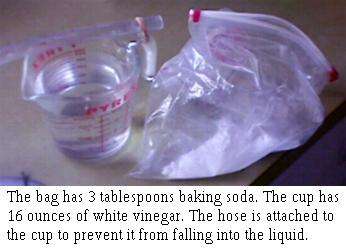
It is best to react the baking soda and acid in a separate container, directing the CO2 through a hose and into the euthanasia chamber, because there is a possibility that the fizzing sound of the reaction might frighten the animal. The simplest chamber is a plastic bag about 1 gallon in size. Put 3 tablespoons of baking soda into the bottom of the bag. Use a 2-cup measuring cup or a 16 oz glass and secure a 3-foot piece of 1/2 inch hose (vinyl hose is sold by the foot in most hardware stores, or a section of garden hose could be used) to the outside of the cup or glass near the top with a rubber band or tape.
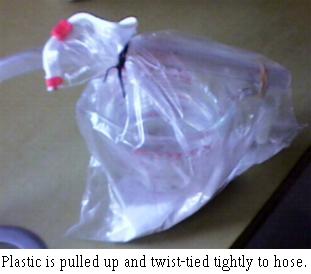
Fill the cup or glass with 2-cups of vinegar, and set it in the bag on top of the baking soda. Pull the excess plastic up and wrap it tightly around the hose, securing it with a wire twist tie. Make sure you don't spill any of the vinegar.
The Euthanasia Chamber
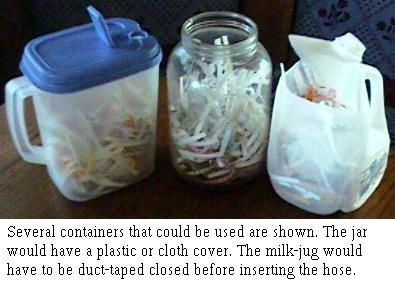
If the animal is largely inactive and small enough (CO2 euthanasia is not recommended for animals over 2 pounds), a one-gallon jar or juice pitcher works well, or a one-gallon plastic jug could be used if the top is partially cut off so it will hinge up and can later be taped closed. A box, open only at the top and about the size of a gallon jug, could also be used. Add familiar litter (for rodents), a special toy, or whatever might comfort your pet. Making a little nest and covering it with a cloth, or wadded or shredded paper, may help calm and comfort your pet as much as possible. Covering also prevents wandering about during the final minute. If the animal were free to walk about it would begin to stagger and act drunk or confused before loss of consciousness. This is not something you want to see--not how your pet would want you to remember them, so limit your pet's ability to move about. It may even be possible to get your pet to fall asleep.
If you are using a jar, cover the top with a piece of plastic with a hole made in it for the hose, and another small hole to allow the air to escape as the CO2 enters. You might want to suck on the hose to remove most of the air in the plastic bag containing the baking soda and container of vinegar before putting the hose into the euthanasia container (if you do a good job of pulling up all loose plastic, this step should not be required).
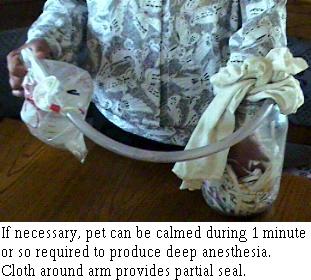
If you must hold the pet in order to comfort it, you could put your arm in the container along with the end of the hose, and wrap a cloth around both to partially seal the opening. The air in the container must be permitted to escape as the CO2 enters, so make sure the top is not completely sealed.
Initially the hose should extend about 2 inches into the chamber. When all is ready, hold the cup or glass through the plastic bag, and slowly pour out half of the vinegar so that it takes about 1 minute to pour one cup out and into the bag (leaving one cup of vinegar still in the cup or glass). You will hear a fizz as the acid reacts with the baking soda. Gas will begin to fill the bag, then flow through the hose and into the euthanasia chamber. Make sure the hose doesn't fall into the liquid, as the expanding gas would then force the liquid through the hose. Since CO2 is heavier than air, it will fall down into the euthanasia chamber mixing with the air, and so gradually increase the CO2 concentration. In 1 to 2 minutes the animal should be in deep anesthesia and breathing deeply. Touching an eye should produce no response. If you are holding your pet, it will be completely limp. If you are not holding the animal and can't see it, just shake the container a bit and listen. There should be no movement. Do not open the container to check or reach in as this will introduce air and possibly reawaken the animal.
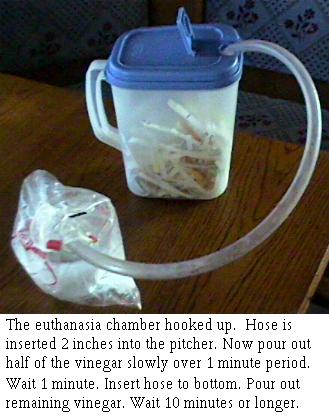
Finally, push the hose down near the bottom of the container and pour out the remaining vinegar into the bag. When most of the fizzing subsides, you might squeeze the bag, if it seems to contain a lot of gas, to force out the remaining CO2. This final flow will flood the chamber with a high concentration of CO2 stopping respiration in minutes if not seconds. Now cover the chamber and wait 10-30 minutes before checking (longer for amphibians or reptiles).
Rats euthanized by increasing CO2 levels to 33% over 1 minute, then killed using high levels of CO2 while still in their home cage showed no signs of stress either by behavior or by subsequent blood tests for ACTH, glucose, and corticosterone which would be abnormal if the rats had experienced anything distressing. 2 This is strong evidence that CO2 euthanasia is as "good" a death as can be achieved in a home setting.
Materials Required
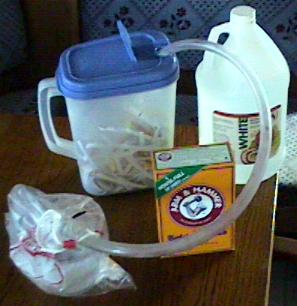
1. One gallon of white vinegar.
2. One pound box of baking soda.
3. Tablespoon to measure baking soda.
4. One-gallon container: Jar, pitcher, plastic jug, or box with opening only at top (euthanasia chamber).
5. Hose, 1/2 inch inside diameter, about 3 feet long.
6. One gallon size plastic bag--zip-lock works well (carbon dioxide chamber).
7. Twist tie to secure plastic bag to hose.
8. 16-ounce cup (measuring cup) or 16-ounce glass.
9. Rubber band or tape to secure hose to cup or glass on the outside near the top.
10. Plastic or cloth to partially seal the top of the euthanasia chamber around hose, or arm and hose, if using a jar or box.
Variation in Method
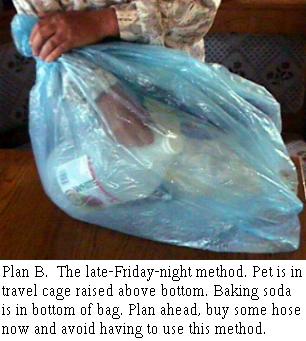
If the animal is too active, or you can't obtain the materials needed for the above procedure, you could put the animal in a small cage, a travel cage, or box with holes in it. Put about 1 and a half cups of baking soda in the bottom of a large plastic bag. Put the cage or box into the bag raised about 4 inches above the bottom. Open a gallon jug of vinegar and reach into the bag with it. You might want to put a barrier between the cage and jug so none can accidentally be spilled into the cage. Gather up as much of the plastic as you can around your arm so that as much air has been removed as possible and tie or hold the bag about your arm tightly. Slowly pour out the vinegar so that about a quarter of it has been poured out over a period of about 1 minute (or until the volume of the bag has inflated so it is about 1/3 larger than it was). Set the jug down inside the bag and fan the air with your hand to mix air and CO2 for about 1 minute. Then loosen the bag around your arm a bit to allow gas to escape, and continue to pour the vinegar out until the jug is empty. Remove your arm and close the bag. Wait at least 10-30 minutes before checking to verify death. As mentioned, one problem with this procedure is that the fizzing might frighten the animal.
A Euthanasia Machine
A high degree of control is not possible in the procedures described above. The results depend on how fast someone actually pours how much acid; the rate the acid mixes with the baking soda; how much air was initially in the carbon dioxide chamber; how well the CO2 mixes with the air in the euthanasia chamber as it enters; and then there are concerns over operator error. To do a significantly better job would require a euthanasia machine. One possible design is shown below. It eliminates a lot of variables, is consistently effective, but requires more time, money, and tools to build.
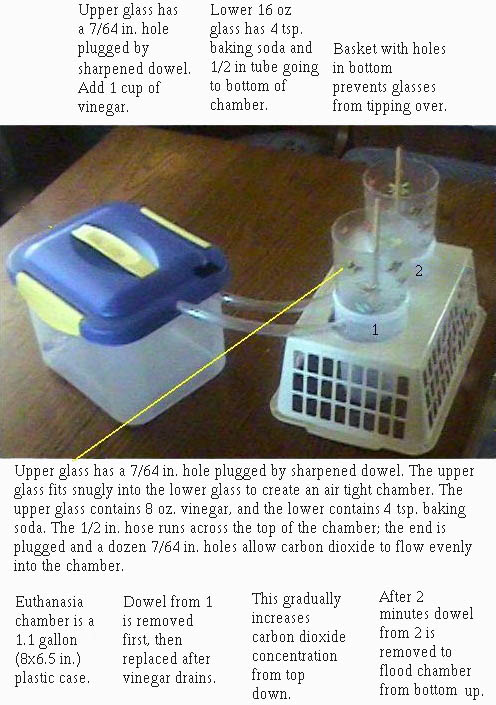
In this design there are two carbon dioxide chambers. Each is formed by two plastic glasses. The upper one fits tightly into the top of the lower one to create an airtight chamber. A 1/2-inch tube runs from each lower glass to the euthanasia chamber. Each upper glass has a 7/64th-inch hole drilled into the bottom and is plugged by a sharpened dowel (insert with a twisting motion without pushing too hard and possibly cracking the plastic). The hose from the first glass runs along the top of the euthanasia chamber, is plugged at the end (a piece of sponge works), and has a dozen or so holes drilled into it so that the CO2 is evenly dispersed as it enters the chamber. (The lid of the chamber had spaces where the handle goes through it, so no holes had to be made to allow air to escape as CO2 enters.) The hose from the second glass goes to the bottom of the chamber. The bottom of each lower glass is covered to a depth of about 1.5 inches with bits of moistened sponge, or open-cell foam, cut into 1/4 inch cubes on top of which the baking soda is added. This prevents the baking soda from forming a solid layer on the bottom of the glass, and so promotes a more rapid reaction with the acid. Another way to promote a complete reaction is to place a moist piece of heavy cloth, like a wash cloth, in the bottom of the cup and cut so it extends up the sides about one inch, then put the baking soda on it.
Removing the dowel from the first glass releases the vinegar to begin the process of gradually increasing the CO2 level in the euthanasia chamber and thereby inducing a state of deep anesthesia. After about 1 minute, the vinegar drains and the dowel is replaced. After waiting an additional minute, the dowel in the second glass is removed, the vinegar flows into the lower glass, and CO2 floods the chamber from the bottom up causing rapid death. After the second cup drains, replace the dowel and wait at least 10 minutes. Be sure to a few test runs first, making sure all the baking soda reacts (swirl the glass and if few or no bubbles form, then the reaction was complete).
One option would be to cut a circular hole in the end of the euthanasia chamber so your hand could be inside to hold and comfort your pet. To seal the hole, use a bracelet or wire ring a bit larger than the hole, then stretch a surgical latex glove over it and cut off the fingers and thumb. Adjust the ring so that, when your hand is inside, the glove seals the hole.
Concluding Remarks
Important: Whatever you do, do one or more dry runs without the animal first. Practice the procedures until you are comfortable performing them without mishap before doing anything involving your pet.
Since 2003, when this site when up, I have had numerous reports of success and only one report of failure from someone who had no idea what might have gone wrong and who apparently was unable to understand the instructions provided. The lesson would seem to be: know your limitations.
Some non-believers in science question the need for experimentation, but I am quite sure that the procedures detailed above could not have been developed without some experimentation, and that to guess without testing would have been grossly irresponsible. Accordingly I wish to acknowledge the invaluable contributions of eight wild house mice, uninvited and destructive guests, who would otherwise have met their end in a mousetrap (sorry but allowing mice around our house in the country attracts way too many rattlesnakes, and I have a family to consider). Fortunately all I had to do was to verify that my methods, based on the research of others, were producing the same results as reported by real scientists who did all the real work. When I could put a wild, stress-out mouse to sleep without any apparent added distress, I ended my experiments. (Some mice, not partially confined by shreded paper and with room to wander, acted drunk, and staggered about for about 20 seconds before becoming unconscious--not a pretty sight, but they appeared more confused and disoriented than in pain).
Dry ice is used by some labs for CO2 euthanasia. Dry ice is a potentially hazardous substance. It is obtainable, but not readily available, and may not be obtainable at all when actually needed. The rate of sublimation in air is too slow, and adding dry ice to water results in violent, possibly explosive, boiling. It is difficult to control the rate of flow. Cold burns to you or your pet are a real hazard. Dry ice is not something you want to fool with at home.
While all vets should know how to perform humane euthanasia properly, some may not want to bother. If possible, do go to a vet, but make sure you observe the procedure, and if the vet doesn't want you to observe, go elsewhere. The preferred method (with small mammals) is to induce anesthesia using an inhalant such as Halothane or Isoflurane, followed by lethal injection or overdose of the inhalant. Some vets, when not being observed, may skip the first step and just inject something lethal into the body cavity.
At-home use of inhalant anesthesia is advocated by some as the best method of do-it-yourself euthanasia. Halothane, Isoflurane, Methoxyflurane, and other inhalant anesthetics are controlled substances obtainable (so far as I know) only by licensed veterinarians or researchers and are not legally available to the public. Some are being abused by a few recreational drug users, so it might be possible to obtain them, but even if you could, they are not appropriate for home use. First, with the exception of Methoxyflurane which is no longer available in the USA, inhalant anesthetics can only be used properly with an anesthesia machine capable of delivering them at the proper concentration (5% initially), and rate. Second, for your safety, you would also need a gas scavenger to protect yourself from fumes. Inhalant anesthesia is not a practical method for most pet owners.
Some claim that CO2 euthanasia is inhumane and should never be considered. This is based on the mistaken belief that CO2 acts only by inducing asphyxiation. Using it is likened to smothering your pet to death with a pillow; however it is a well established fact that carbon dioxide is a rapid depressant and powerful anesthetic. My observation is that CO2 acts as quickly and with even less excitation than Isoflurane, perhaps because it is nearly odorless. At high concentration CO2 does indeed kill the animal by hypoxemia, but only after induction of anesthesia. Even within the scientific literature you can find some misinformation. Procedures often call for precharging the euthanasia chamber with concentrated CO2 because this will cause the most rapid death. This is true, but speed is not the most important consideration. It is now realized that high concentrations of CO2 are noxious and inflict pain before induction of anesthesia. A gradual increase in concentration avoids this.
Some vets are concerned that CO2 euthanasia is ineffective in causing death and that some additional procedure is required to be sure death has occurred. This is an odd concern, at least with rodents, because respiration during the anesthesia phase is quite obvious as is the cessation of all respiration shortly after the high concentration CO2 is introduced. Neither mice nor men can stop breathing for 10 minutes and then revive (except in cases of hypothermia or animals that have evolved extraordinary breath holding abilities). If you have any concerns, wait 30 minutes or longer. The AVMA doesn't seem to have this concern.
I have received requests for a method that would be suitable for larger pets. I have recently become aware of the helium/nitrogen bag method of ethanasia advocated by right to die groups like Final Exit. This method of at home euthanasia for humans works by asphyxiation, but reportedly without causing distress. Helium is readily available for filling party balloons, and so this would be a practical method, but one I have not tried.
I am glad to have this highly effective and practical method of at-home euthanasia, and hope others will make good and responsible use of it should the unfortunate need arise. Finally, I would like to thank all of those who have written to me to express their appreciation for the information in this paper, and for letting me know that much pointless suffering has been prevented. An unexpected result has been that much human suffering has been reduced as well.
References
1. Report of the AVMA Panel on Euthanasia, JAVMA, Vol. 218, No.5, March 1, 2001
2. Hackbarth H, Kppers N, Bohnet W. Euthanasia of rats with carbon dioxide--animal welfare aspects. Lab Anim 2000;34:91-96
3. Leake CD, Waters RM. The anesthetic properties of carbon dioxide. Curr Res Anesthesiol Analg 1929;8:17-19

- Visit our Zazzle store:
Fine poetry and art go together. Support this site: Visit our Zazzle store featuring ultra hi-res images of artworks, Hubble/ESA/NASA space images, Mandelbrot fractals, maps and more. Images up to 525 megapixels allow for fine printing at the largest sizes. Consider giving a fine print as a gift that could hang on someone's wall for a hundred years or more.
Other sites by Alysion
- World's Funniest Jokes
- Survival Retreat? Maybe now is the time
- For wisdom: follow The Path of the Dog
- Beginnings: First Lines from Scriptures
- World Religion Simplified
- The Diamond Sutra: Condensed version
- The Platform Sutra of Huineng: Condensed
- The Tibetan Book of the Great Liberation
- The Zen Teachings of Huang Po on the One Mind
- Zen and the Art of Mindful Bus Riding
- Private Retreat: Alysion Acres
- Two Zen Stories
- 14 Mindfulness Trainings of Thich Nhat Hanh
- 14 Thoughtfulness Trainings
- Westfulness and Eastfulness
- Mindfulness Meditation Bell, Gong, Timer
- Buyer's Guide to Food Preparedness Products
- Alysion Acres: An intentional community
- Poems to Memorize & Memorable Poems
- Mom's Favorite Poems
- Ryan's Favorite Poems
- WWW Collection of Favorite String Figures
- Take the Super Post-Mensa IQ Test
- Alternative Handwriting and Shorthand Systems
- Handywrite
- Making the Tree of Life: Fun with phylogenetics
- Human Chow: The Website
- Fun with Dimensional Analysis
- Medication Math for the Nursing Student
- Walled-in: A poem
- Making Boxes for your Rock & Mineral Collection
- Making a Mass Balance Scale
- Ryan's 50 States Flashcards
- Adventures of MeraLee
- World Religions Simplified
- eBike Touring Association
- The True Right to Life Movement
- Cochise Stronghold Trail
External Links
- Animal Euthanasia
- Wikipedia article.
- Special-Needs Pets
- Article with general information.
- AVMA Brochure
- Info from the American Veterinary Medical Association.
Top 10 Poems from Alysion's
Bucket List of Poems
to Read Before You Die
- 1. The Rainy Day by Henry W. Longfellow
- 2. Fire and Ice by Robert Frost
- 3. A Dream within a Dream by Edgar Allan Poe
- 4. The Purple Cow by Gelett Burgess
- 5. If by Rudyard Kipling
- 6. To See a World by William Blake
- 7. Ten Little Limericks
- 8. First Fig by Edna St. Vincent Millay
- 9. Alone by Edgar Allan Poe
- 10. I'm nobody! Who are you? Emily Dickinson